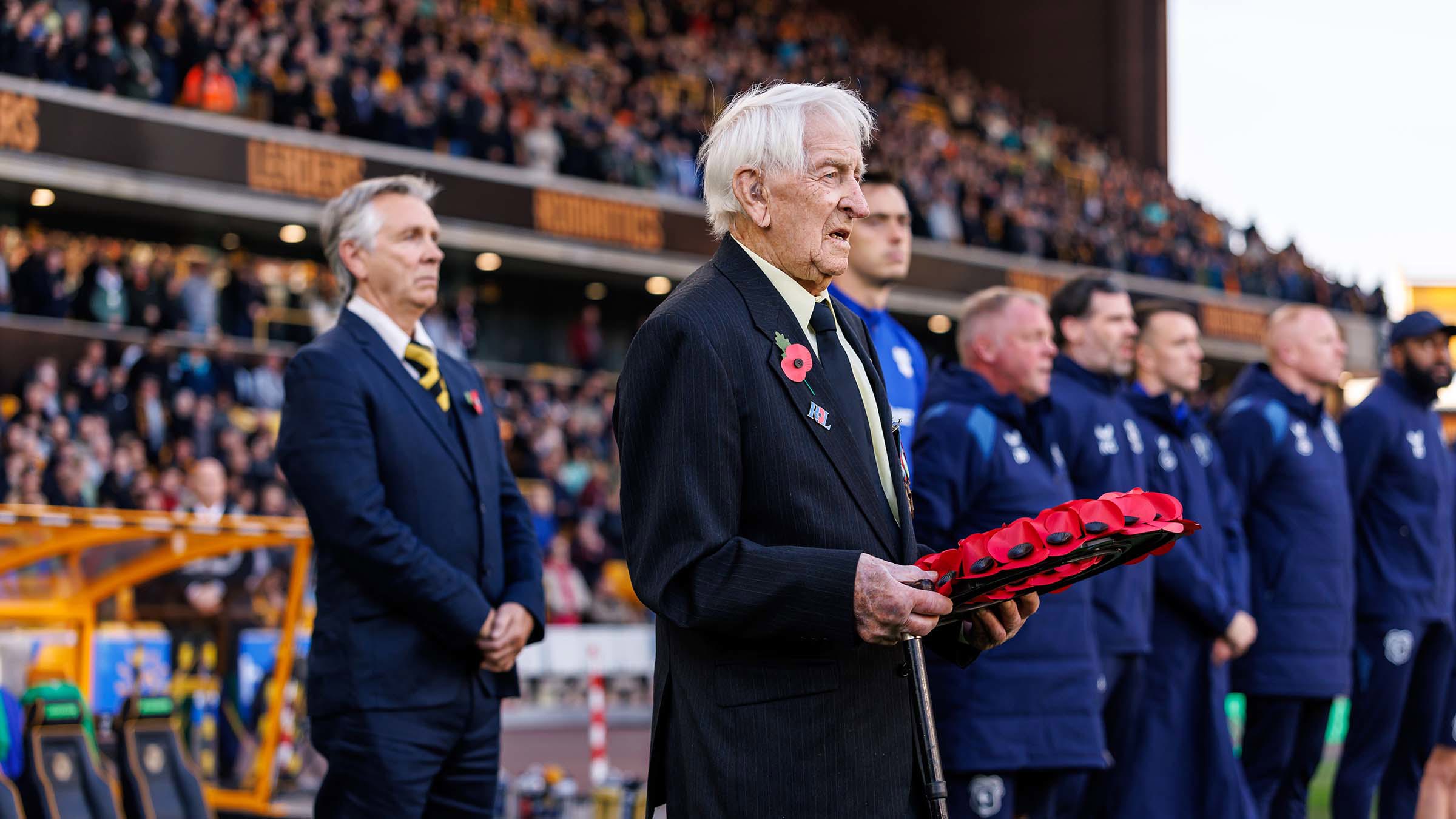
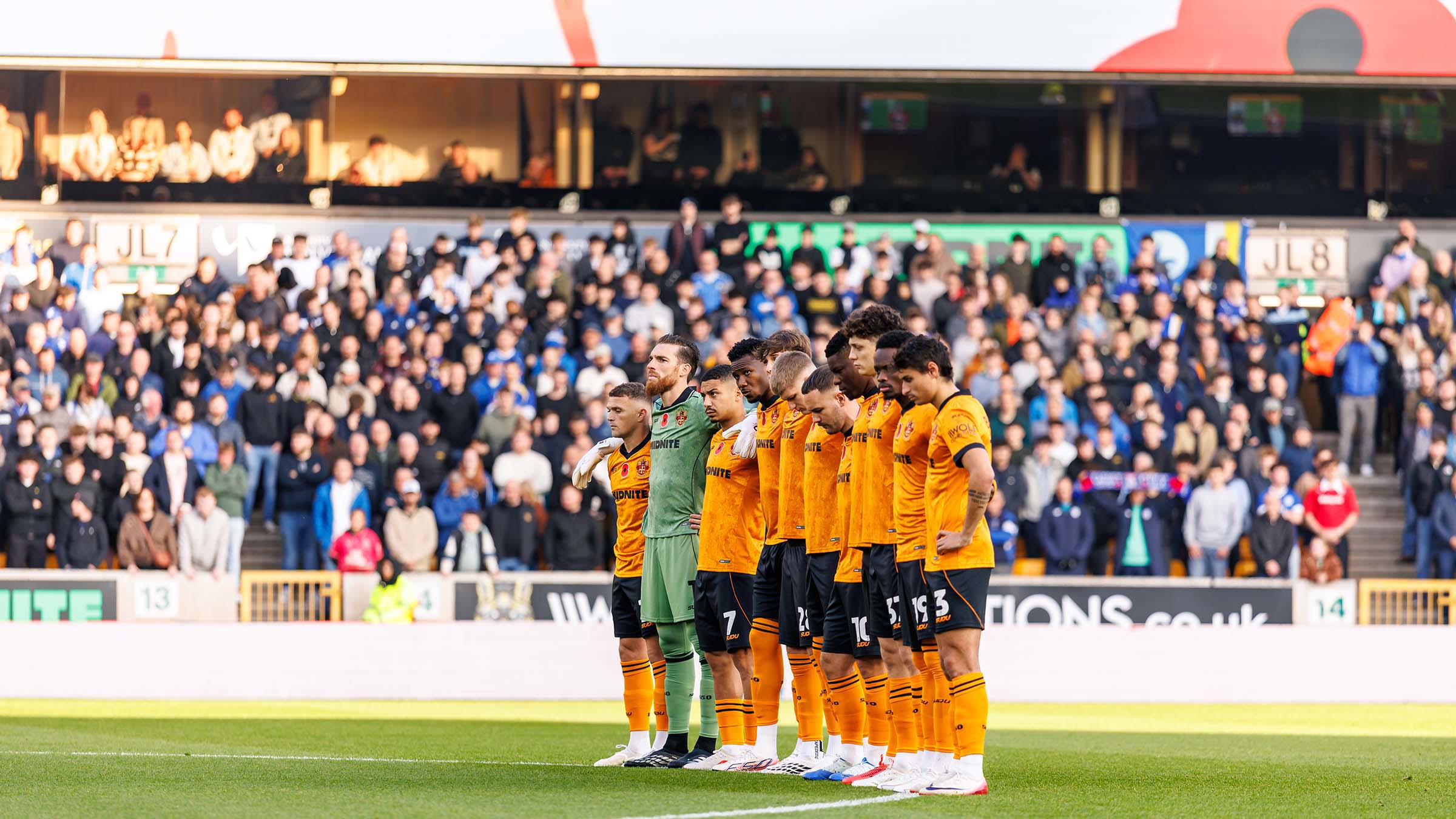
During Wolves’ Championship fixture against Cardiff City, both teams came together to commemorate the lives of those which have been lost in conflict and those who are currently serving their country.
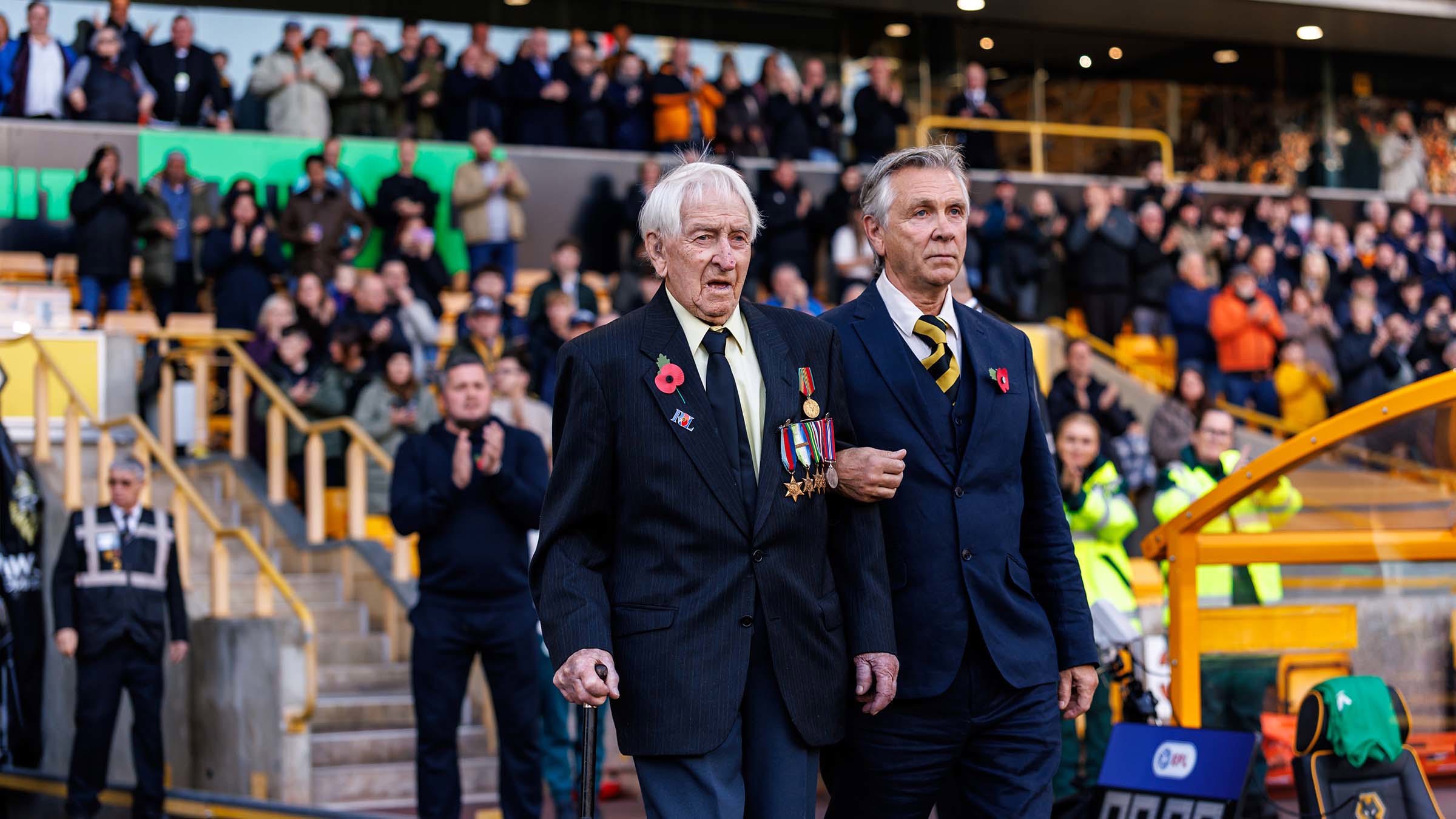
As part of Wolves’ 2026 Remembrance fixture, we thanked all of those who have served in the armed forces, including 101-year-old Old Gold supporter and former Navy seaman, Robert ‘Bob’ Gelder.
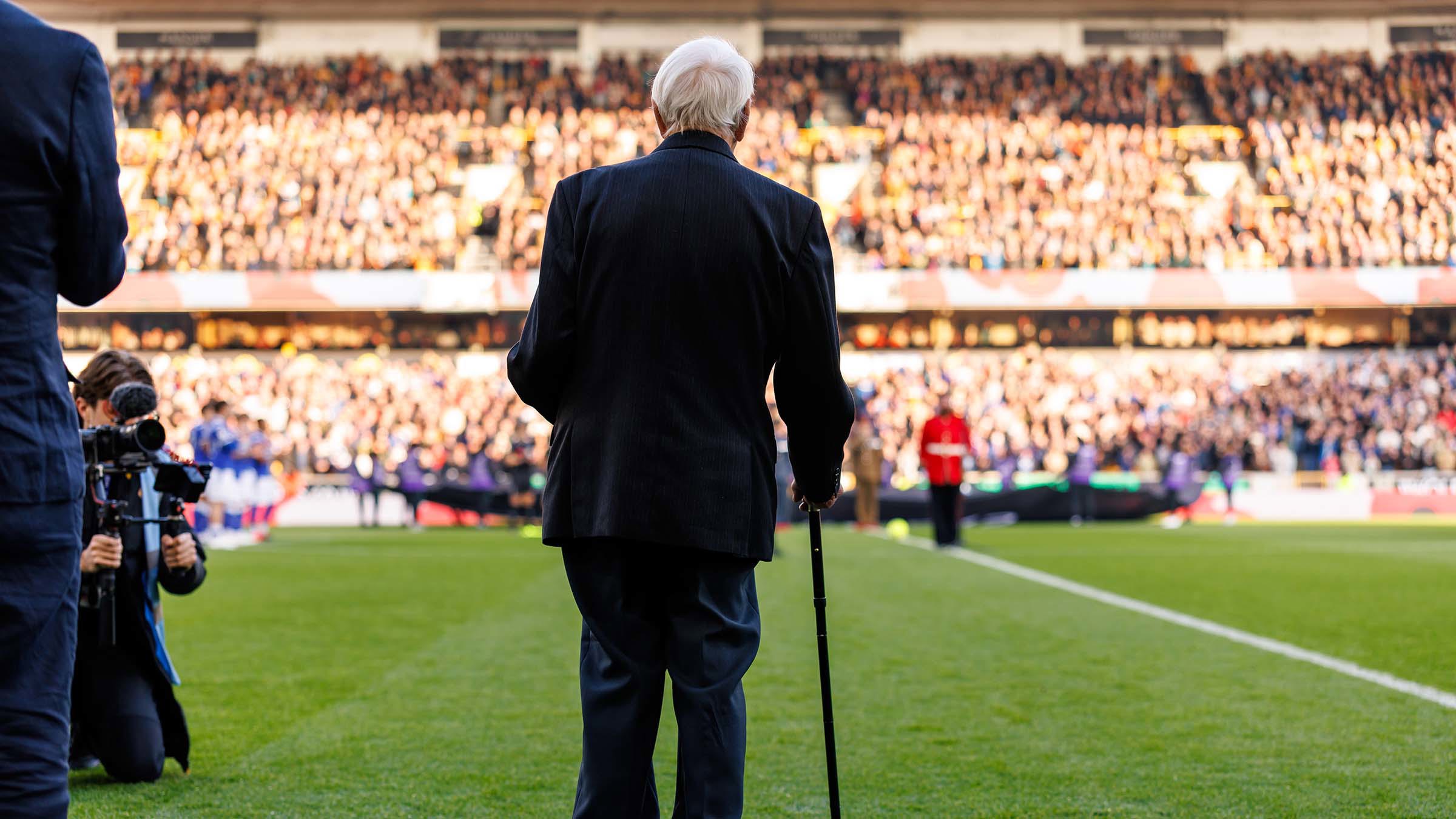
Bob – who walked out at Molineux ahead of the match against the Bluebirds – has reflected on war, Wolves and a century of memories with the official matchday programme, but there is one chapter which still stands above all others.
Facing the storms of the Atlantic, the Arctic and a Pacific Ocean, where a wave broke his jaw and yet he completed his watch before seeking treatment, Bob was transformed by his time serving in the Royal Navy.
“It is one of the best parts of my life,” he said. “I was turned from a sick kid into a man.”
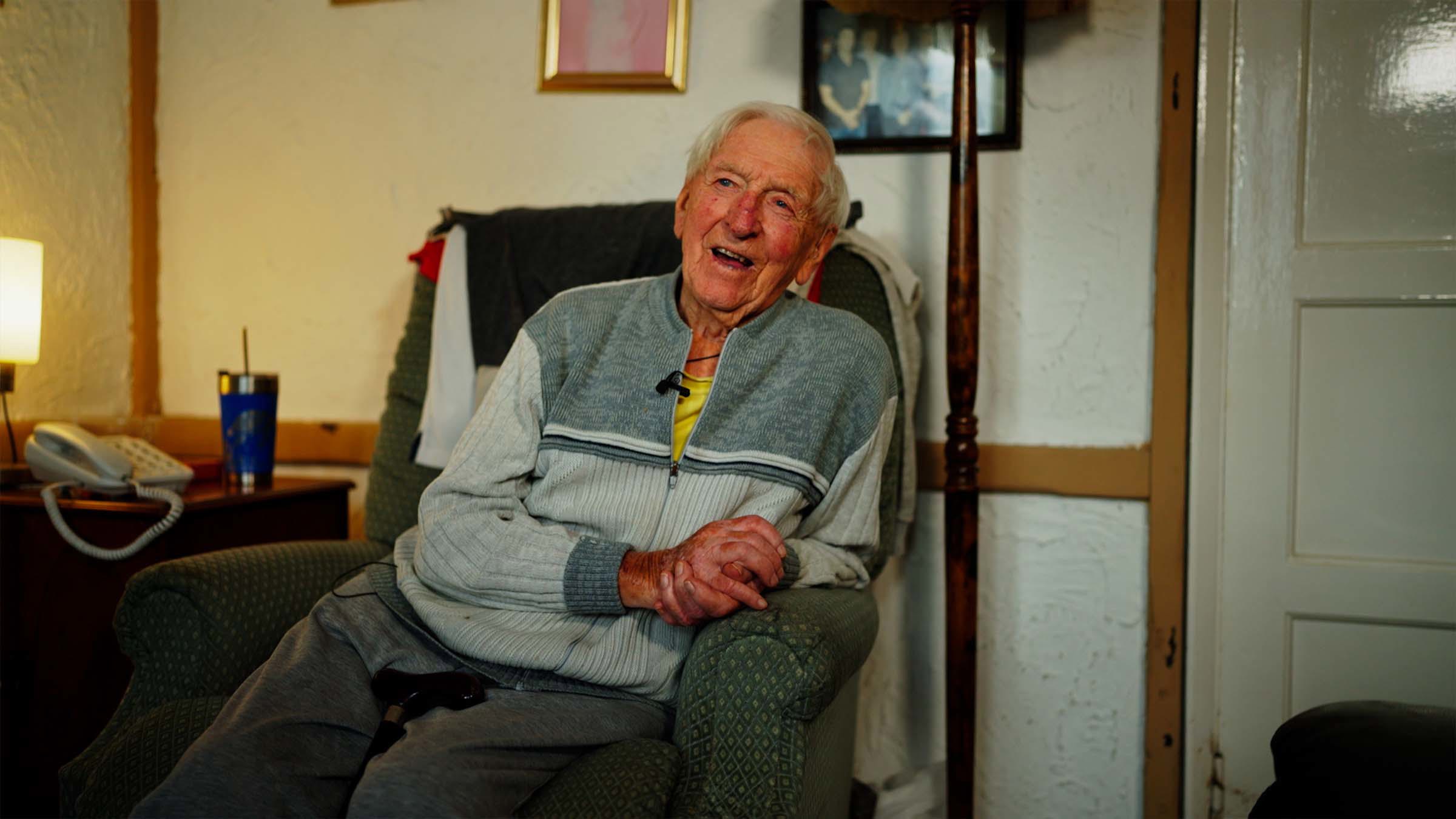
Born and raised in Tipton, Bob grew up during the hardship of the inter-war years. Money was scarce and work was hard to find, while families relied on one another to get by.
“I think all the people round where we lived were poverty-stricken, really, and we used to help one another out.
“We lived in a yard with five houses in it, everybody more or less lived in one another’s houses, and we all helped one another out because fathers weren’t working and things like that.
“Next door to us, the woman had two sons who were miners and every now and again they’d get a free load of coal. They’d tip it up and she shared it out amongst people who couldn’t afford any. Food as well. I’d eat in other people's houses if they had something special.
“Every house today is an island. I don’t really know the people who live here or there, they just don’t mix, but in my day, everybody knew more or less one another. We were all in the same boat.”
Bob’s early years were made even more difficult by ill health. He suffered repeated bouts of pneumonia as a child and spent around a year in Dudley’s Guest Hospital, where fresh air was considered the best medicine before doctors eventually concluded that one of his lungs had been permanently damaged.
“He said, ‘He’s got one lung that’s perfect, but the other one ain’t much good.'”
When his Second World War call-up papers arrived shortly after his 18th birthday, it seemed unlikely he would pass the physical requirements for military service, and at first, he didn’t, but the Navy saw potential.
Bob was sent to a specialist training school in Bristol, where weeks of relentless physical conditioning followed.
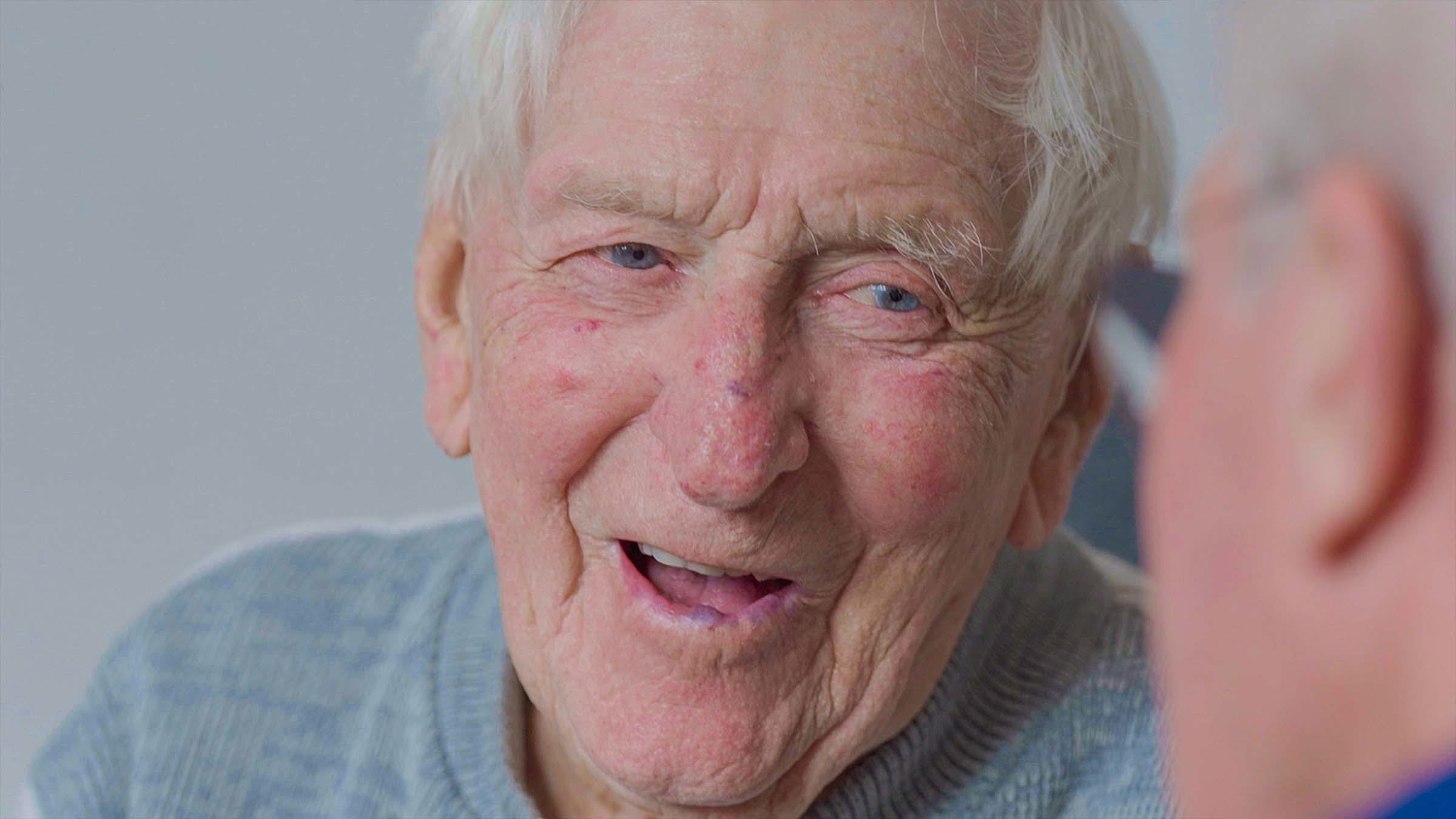
“I went there and did, I forget how long, about six or seven weeks of physical training. They put me through the mill, I tell you.
“But when I went back for the Navy test afterwards, they said, ‘Perfect, you’re in the Navy’, and that started it all off.”
What followed was an extraordinary wartime journey that would take a young Black Country man across the globe.
Bob trained at Portsmouth and volunteered for a boat which went to Watermouth in Ireland, before joining his first ship, the frigate HMS Dovey, in 1942, although his introduction to life at sea came quickly.
After negotiating the Bay of Biscay as part of a large convoy heading towards South Africa, the ship encountered a ferocious storm.
“Going down, we were told the Bay of Biscay’s supposed to be a bit lively, but we got through there all right. But after that, we ran into a storm.
“God, that was a beauty. I’ve seen seas 30 foot up and down. They’d put the wind up me a bit, I can tell you.”
For almost two years he escorted convoys, hunted German U-boats and operated across the waters off West Africa.
“We were escorting convoys and things like that, taking important people where they were needed. I don’t know why they picked us, but they did.
“That was what I did until our commission was up after two years. By that point, the ship was getting knocked about a bit and the skipper wrote to the Admiralty in London and said he didn’t think the boat could make it back to the UK.
“They got a message back saying if we could cross the Atlantic and get to Bermuda, there was a big floating dock there and they’d repair her. So that’s what we did.”
The dangers were constant, but life aboard the ship brought people together.
“It’s how you make your friends, you know. We’re all in the same boat, so we’ve all got to pull together. That’s just how it is.
“Sometimes you’d get a bloke that you didn’t get along with, but you couldn’t kick him out!”
Having experienced life and death situations during his role as a torpedoman upon the HMS Apollo, Bob discusses those incredible scenarios with remarkable understatement.
“I remember being in one of the South African convoys. A ship had been sunk and they thought it might have damaged the submarine, but they weren’t sure, so they sent us out to investigate.
“We found it but there was nothing we could do but go over the contact. I dropped a depth charge, came back and dropped another.
“We stayed there for a while and the ASDIC operator said, ‘The ping’s still there, but it’s a different tone. It’s definitely damaged’.
“But unless you can see debris come up from the sea, oil, clothing, something like that, even men themselves, you can’t claim it. But then we got the word from the convoy to come back because our station was vacant, and we had to scoot.”
While aboard the minelayer Apollo, Bob faced some of the harshest conditions on earth – without getting chance to rest.
“The Arctic was vile. Oh, it was terrible. The cold didn’t help, but the waves were massive. I don’t think I’ve ever been in the Arctic with a calm sea. It’s always rough.
“But the Atlantic was probably the roughest. The waves weren’t always as big, but there were more storms in the Atlantic than anywhere else.
“And the Pacific’s so huge. They’re not really waves there, they’re rollers. They’re all different sorts of seas.
“We were on duty every four hours. Normally it was four on and eight off, but there was one spell where we were on standby duty and it was four on, four off, four on, four off. We were bloody mad at that. Luckily, it only lasted a couple of days.
“The worst watch was the middle watch, midnight till four in the morning. That was a killer. You got no proper sleep. You don’t really get to sleep before midnight, and by the time you’ve finished at four o’clock, the ship’s starting to come alive again.
“You might get four hours’ sleep if you’re lucky. Nobody liked the middle watch, but we did it.”
But amidst the danger and lack of sleep came moments of rare beauty. Sheltering from a storm in Arctic waters, Bob witnessed one of the natural world’s greatest spectacles – the northern lights.
“Unless you’ve seen them for yourself, you haven’t really seen them. They’re marvellous.
“We were tucked away from the storm and all you’ve got to do is look up. It’s astonishing. I’m glad I saw them because I might never have done otherwise.”
Not all of Bob’s memories were so peaceful. During operations in the Pacific, shortly after laying a minefield, Apollo was caught in another punishing storm.
Heading to his station during the middle watch, Bob stepped onto the deck just as a huge wave swept across the ship.
“I came up from below decks, opened the hatch and went out on deck. It was blowing hard. I was making my way to my station when a wave came over, picked me up and threw me against a stanchion and it broke my jaw.
“I carried on with a broken jaw until four o’clock in the morning, then I went to sick bay and the skipper sent word ahead to Melbourne. When we got there an ambulance was waiting on the quay for me.”
His broken jaw meant Bob was hospitalised in Melbourne for several weeks, bringing his wartime service largely to an end – although his adventurous spirit nearly carried him back to Australia after the war.
Having fallen in love with the country, Bob and his wife completed the paperwork needed to emigrate.
“I enjoyed it. I wish I’d stayed on. In fact, when I got demobbed and got home, I applied to go back to Australia. There was a £10 Aussie passage then.
“I’d filled all the forms in, the wife was willing and we hadn’t got any kids, so we were going. I was just going to post the forms the next day when she changed her mind.
“She said, ‘My mum and dad are still alive’, and mine were too, and one thing and another, so I ripped the forms up.
“I’ve always said it’s the worst thing I’ve ever done in my life because I loved Australia. It was great.”
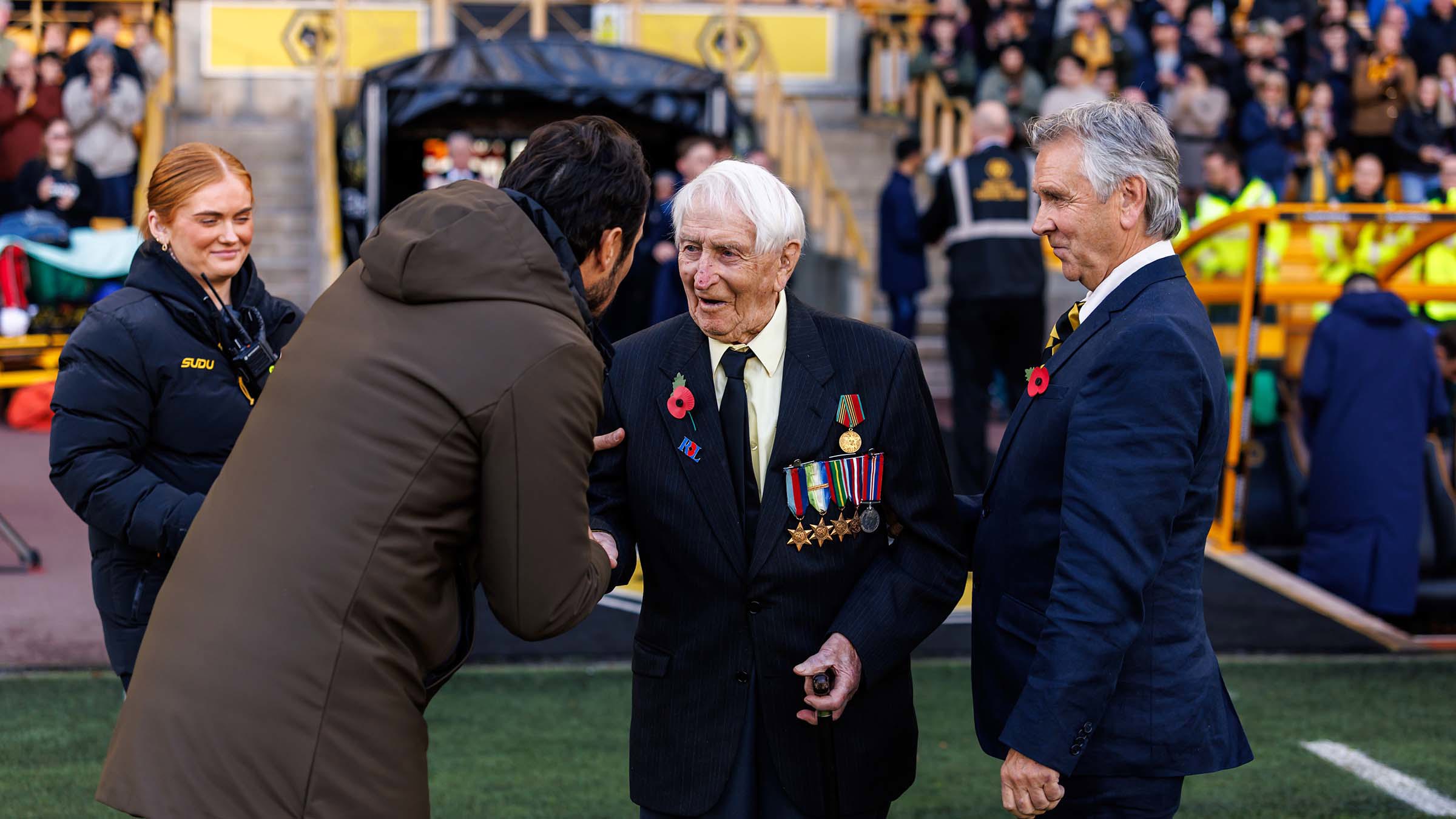
For all his travels around the world, one constant has remained – his support of the Old Gold.
Bob has followed Wolves since he was a young boy growing up in Tipton, making regular journeys to Molineux with his friends whenever money allowed.
Standing on the South Bank, with his bicycle parked nearby for a quick getaway, remains one of his treasured Wolves memories.
“They were good old days.
“The family were supporters and every other Saturday we’d make our way from Tipton to Wolverhampton. There were about seven of us mates when we were 10, 11, 12 years old, knocking about in Tipton and we all used to go together.
“I remember they had a damn good side when Major Buckley had them. There were players like Joey Gardiner and all the old half-backs. I remember Mullen, Hancocks, Dicky Dorsett and Westcott – all of them. They had a damn good side.”
Those trips created memories that have lasted a lifetime, and among them was perhaps the most famous night in Molineux’s history as Wolves were pronounced ‘Champions of the World’ when they beat Hungarian giants Honved in 1954.
“That was a game and a half. Puskas was supposed to be the best player in the world and there was all the talk that he was going to wipe Wolves off the face of the earth and all that, but Billy Wright tied him up.
“Oh, it was a damn good match.”
During this period of remembrance, Wolves joins the country in honouring those who served their nation in battle.
But more than eight decades after leaving home to become a hero, having faced some of the most difficult conditions the oceans could throw at him, Bob remains characteristically humble about his wartime contribution.
“War’s a nasty thing, but I was only a part of it. I didn’t do any more than any other fella.”
Watch more of John Richards’ visit to see Bob on Wolves TV and YouTube.


